Whelan's Reef 2026 - Removal and Remediation Crowdfunder
Please help us remove 50 tonnes of rubbish and replace it with an artificial reef at the Breakwater Fort in Plymouth Sound
We want to improve the health of Plymouth Sound and the Tamar waterway ecosystem, because it will bring benefits to the local marine and bird life, the City of Plymouth and the people who live there. When nature is left alone it is often capable of regeneration, but we are limiting the natural regeneration in Plymouth Sound by leaving polluting materials in the ecosystem. By donating to our Crowdfunder, you can help us remove the polluting material and allow the ecosystem to heal and to thrive.
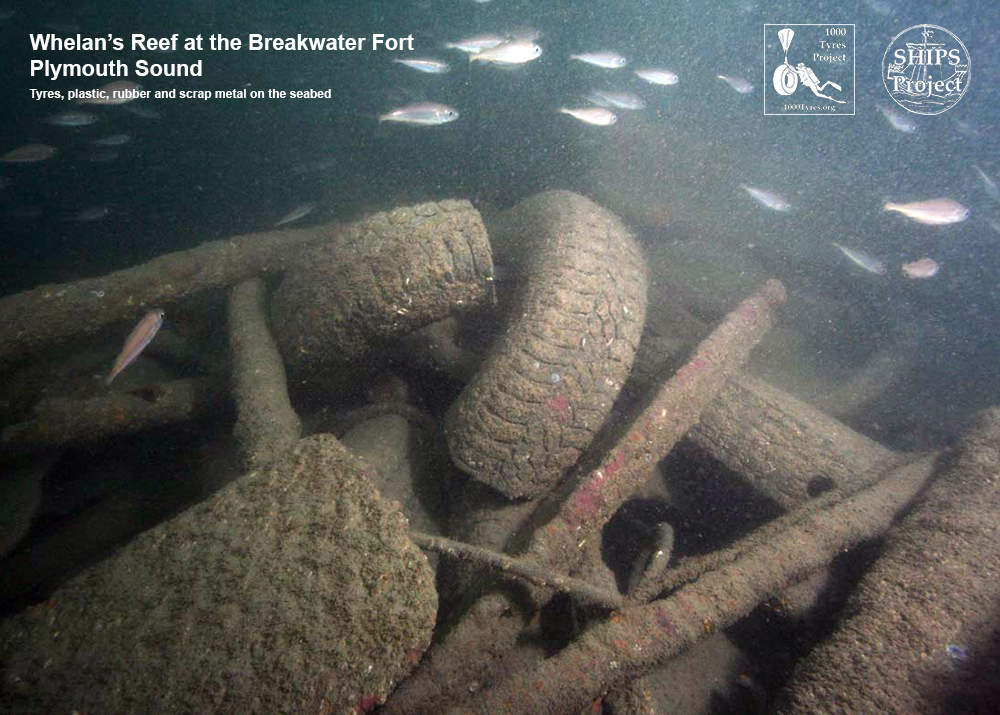
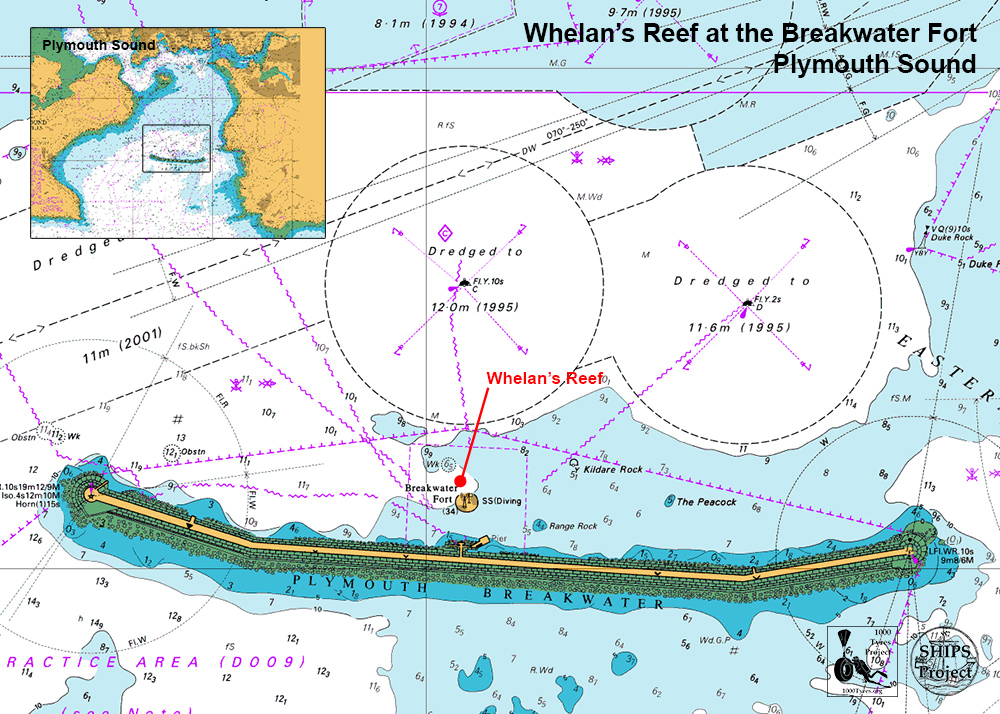
The SHIPS Project CIC, through their venture 1000 Tyres, would like to remove a large pile of tyres, scrap metal, plastic rope and lost fishing gear from the seabed close to the Breakwater Fort in Plymouth Sound. The pile was collected together in the 1980’s by diver trainees from POP Fort Bovisand, who used the Fort as a base for commercial diver training. The 50-tonne pile of marine litter became known at the time as ‘Whelan’s Reef’, even though it was never intended to be an artificial marine habitat.
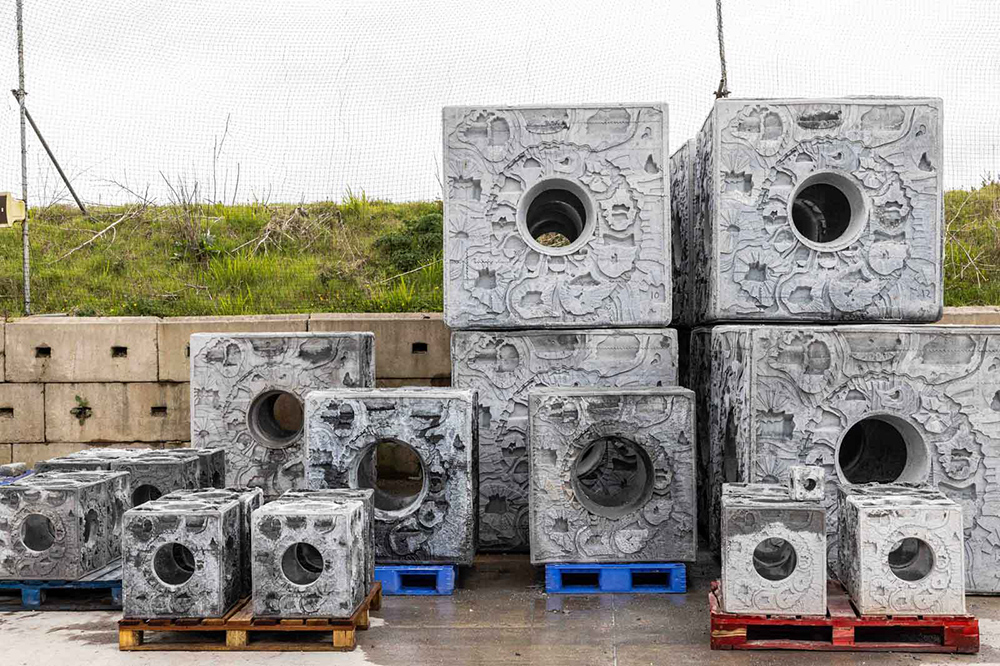
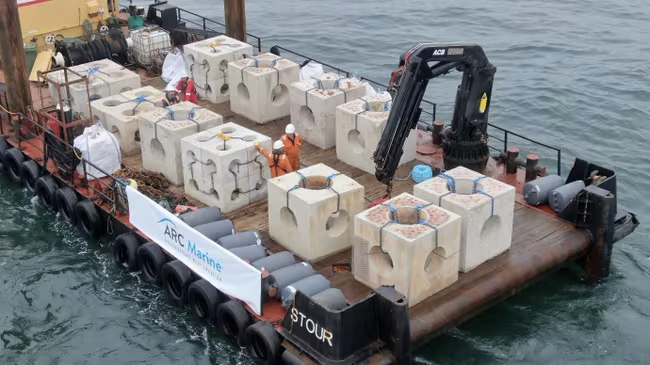
The first aim of the project is to clean up the seabed and remove a large volume of pollutants. The second aim of the project is to replace the large marine litter (rubbish) on the seabed with several concrete ‘reef cubes’ made by Arc Marine, to form an artificial reef in the sheltered water to the north of Plymouth Breakwater.
Unlike our usual clean up operations done using volunteers, this job needs to be done using commercial divers and a crane as the rubbish to be lifted is very heavy. For this we need funging to pay a diving contractor, but we also need funding to obtain the MMO marine license we need to be allowed to do this clean up operation.
When POP diving instructor Michael Whelan started teaching divers at the Fort, the seabed was covered with metal junk and tyres, so with the help of the student divers, they started to tidy it all up into one big pile. The junk was moved to one area, which became known as ‘Whelan’s Reef’. The purpose of the ‘reef’ was often thought to be an artificial reef for improving the ecosystem, but this was never the case; the improvement was to relocate all the junk to just one location. The first aim of this project is to finish the work Whelan started by removing the polluting junk.
To the northwest of the Breakwater Fort lies a pile of tyres, steel scrap and other junk:
Volume: ~60m3
Mass: ~50 tonnes (estimated)
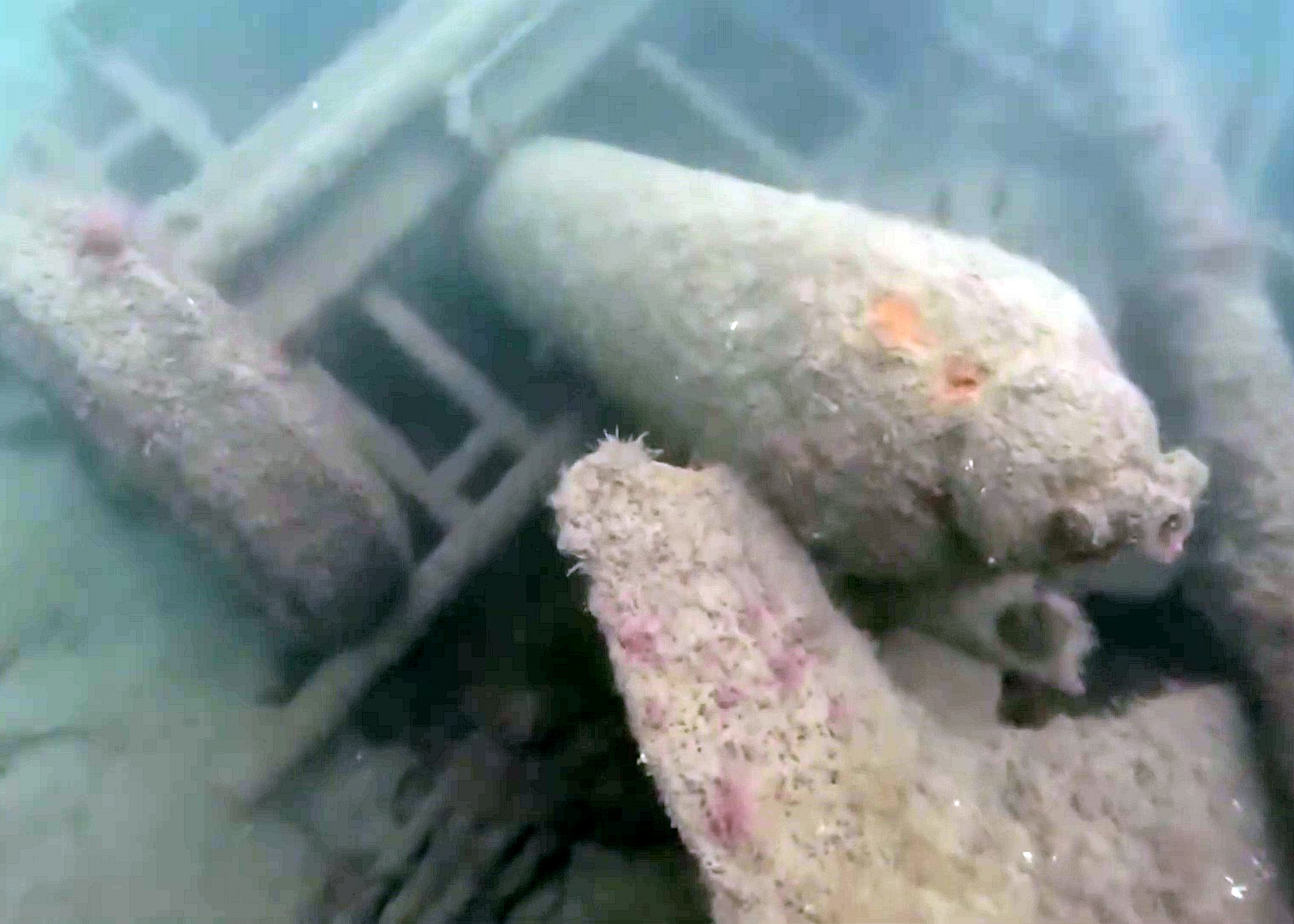
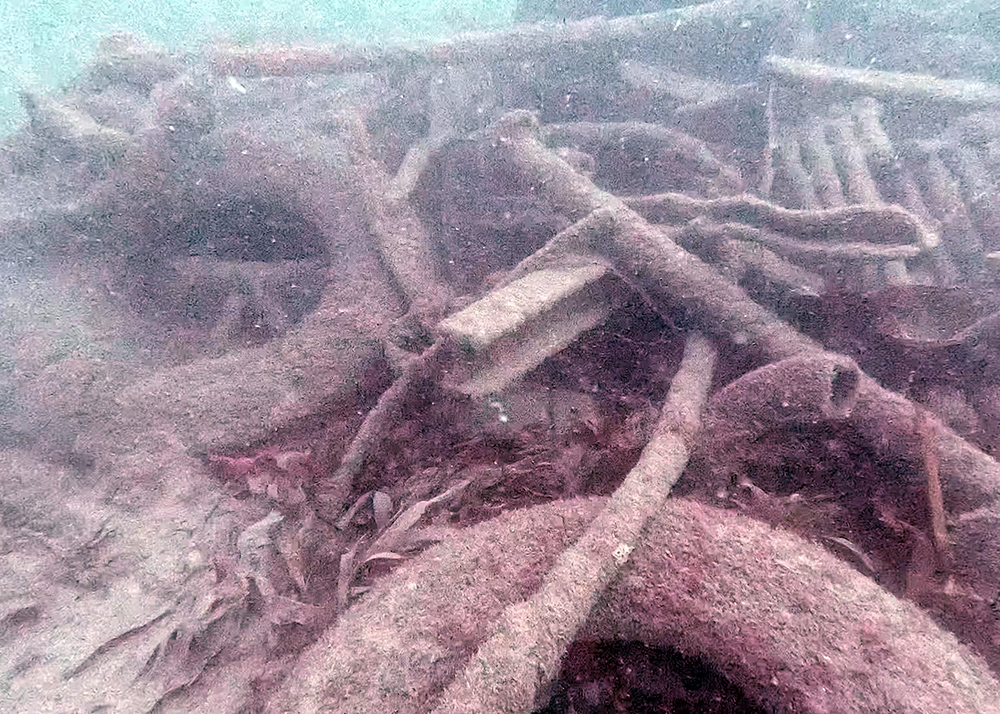
Material: Tyres, steel scrap, gas cylinder, truck axle, net, rope, lobster pots, fibreglass dinghy, fridge
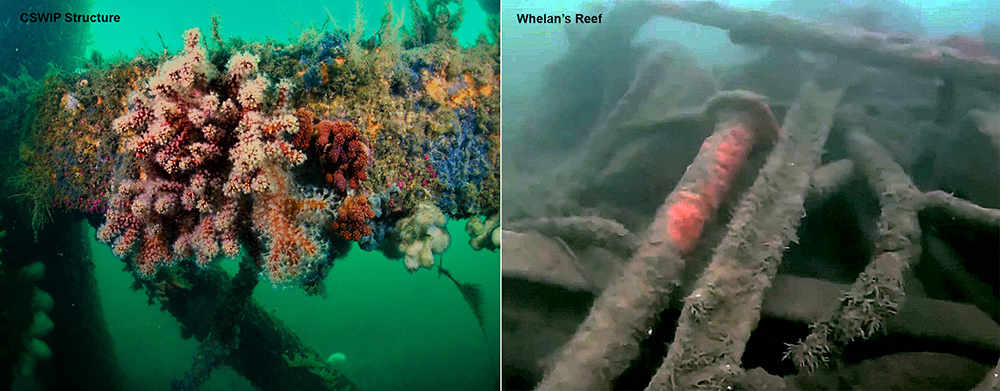
But the effort will be worthwhile. The picture below shows the difference between the abundant marine life on the steel CSWIP structure (left) near the Breakwater Fort and the lifeless Whelan’s Reef (right) which lies just 8 metres away. By removing the marine litter and replacing it with an artificial reef we hope to improve the marine habitat in this area and provide a moreinteresting dive site for sports divers and snorkellers.
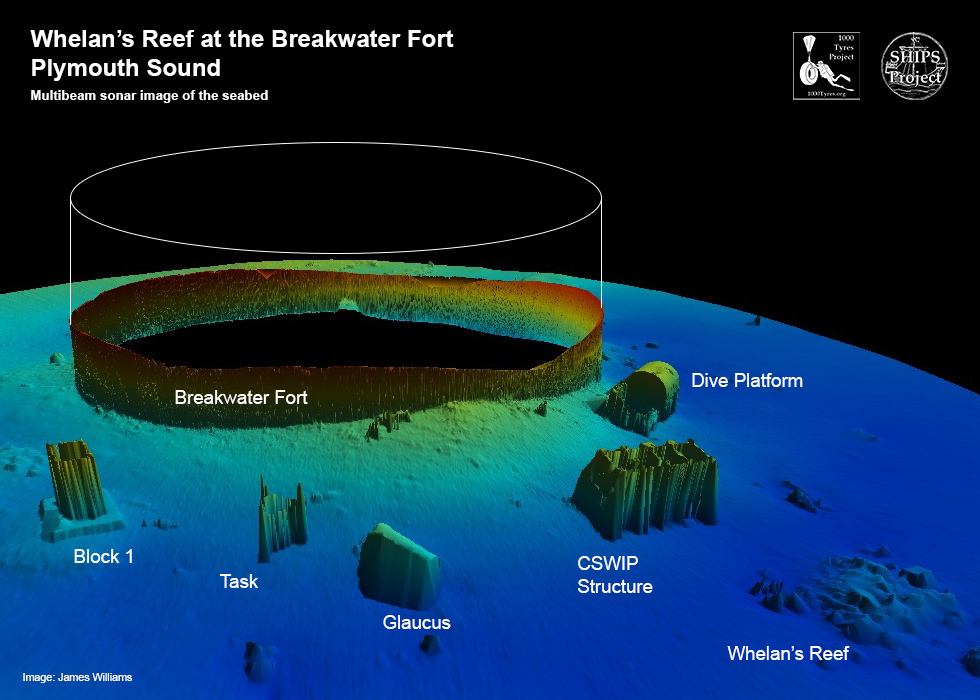
There are several structures on the seabed to the north of the Breakwater Fort, placed there for scientific experiments or for training divers. Many of the structures are made of steel, so are corroding away, and two have already collpsed. Adding an artifical reef made of long-lasting concrete blocks will help replace the habitat lost as the structures corrode away.
Step 1: Removal
- Undertake a pre-disturbance survey of the reef and the marine life.
- Lift and recover from the seabed the scrap metal, tyres and other man-made objects that compose Whelan’s Reef.
- Transport the material to an agreed location on shore where it can be transferred to a handling site in Cattedown, Plymouth, for recycling.
Step 2: Remediation
- Undertake a baseline survey of the seabed and its marine life.
- Add several concrete blocks, likely ARC Marine Reef cubes®
 .
. - Periodically monitor the ecological recovery at the site.
The number of concrete blocks to be deployed on the site depends on several factors, including expert opinion on artificial reefs, the funding available, the cost of purchasing the blocks, the cost of deploying the blocks and the cost of obtaining permission for deployment.
Breakwater Fort was built to the north of Plymouth Breakwater between 1861 and 1879 as one of a ring of forts that were to defend Plymouth against threatened invasion by the French. The fort never saw action during the Napoleonic period but was used as an anti-aircraft station during World War II, before falling into disuse as a military platform. For more information, please see A History of Plymouth’s Breakwater Fort by Peter Holt, published in 2024 by The SHIPS Project .
The Breakwater Fort has been used as a platform for undertaking several scientific experiments and for commercial diver training. In 1965, the Fort was used as a base for the Glaucus Project, where two aquanauts lived underwater in a cylindrical steel habitat for a week. Similar tests were run using the same habitat, but as a joint venture between Imperial College and Plymouth Ocean Projects in 1970.
In 1976, the Breakwater Fort was taken over by the diver training company Plymouth Ocean Projects and used for training commercial divers for work in the challenging environment of the North Sea. The seabed to the north of the fort was the main training area, and several large steel and concrete structures were placed there to be used as test exercises for the student divers.
Commercial diver training stopped in 2000 when Plymouth Ocean Projects ceased trading.
Justification
There are several benefits to undertaking this project:
- It removes approximately 50 tonnes of marine litter from Plymouth Sound which will improve the ecosystem.
- It removes several tonnes of pollutants from the marine environment, including decaying plastics, heavy metals including lead, copper and zinc, as well as toxic organic compounds.
- The replacement reef blocks create sheltered habitats for marine life, offsetting the polluted habitats offered by abandoned tyres removed from the seabed. This habitat is particularly important for lobsters (Homarus gammarus) and brown crab (Cancer pagurus) both are commercial species and are in decline.
- It provides an opportunity to study the development of a regenerated marine ecosystem.
- It provides an opportunity to engage the public in a direct action project where the improvements can be demonstrated.
- Improving the site may enhance dive tourism if there is more marine life for divers to see.
The project complies with several action items identified in the Tamar Estuaries Consultative Forum Plymouth Sound and Estuaries Management Plan 2025-2030 . The Management Plan provides a framework for managing the Plymouth Sound and Estuaries and the Marine Protected Area (MPA).
Permissions will be obtained from the seabed owner and all relevant authorities before undertaking this restoration project.
To get involved, or to find out more about the Whelan's Reef project, 1000 Tyres or The SHIPS Project CIC, please contact us here .
Mapping Whelan's Reef
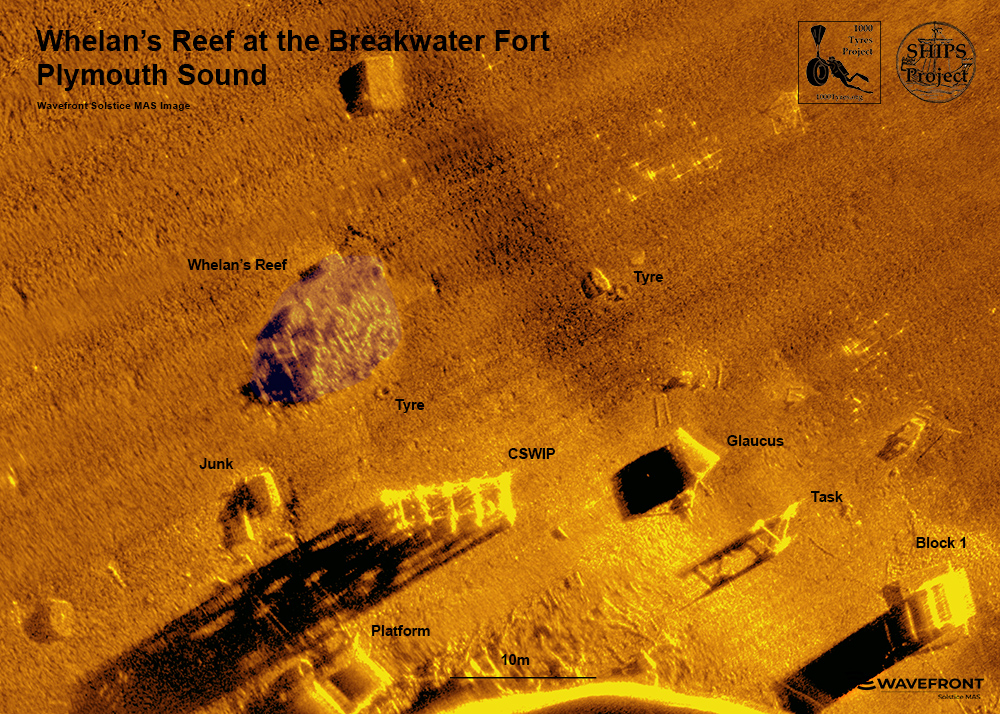
Whelan's Reef was mapped using a novel high-resolution sonar, followed up by a video survey by SHIPS Project divers.
We used a Forcys Solstice Multi-Aperture Sonar (MAS), which uses sound signals to produce very high-quality images of the seabed. The Wavefront Solstice family of sonars are built on unique Multi-Aperture Sonar (MAS) technology and is designed to fill the gap between standard low-resolution side scan sonars and complex Synthetic Aperture Sonar (SAS). Solstice was used for this application because it produces very high-resolution images, recording details on the seabed as small as 1.5cm x 3.75cm in a fully-focussed swath 200m wide, at a maximum coverage rate of 160 Ha per hour.
The divers recorded Whelan's reef using underwater video cameras, creating a tour of the site and orthoimages that will be ussed to create a 3D photogrammetry model. The video shows a distinct contrast between the abundant marine life on the CSWIP structure and the barren Whelan's Reef 8m to the north.
More about Forcys Solstice MAS
Last updated 20 September 2026